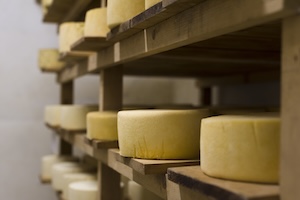
Shelf life and the ageing process: how wax enables continued development
Wax allows cheese to continue its natural development.
Unlike completely closed packaging systems, such as vacuum packaging, waxing permits controlled degassing and evaporation. The cheese can release moisture and gases as part of its maturation process. This supports a more natural ageing process and influences both flavour and structure – something many producers, as well as consumers, consider to be an improvement.
During storage, this can result in a firmer texture, a more defined structure and a more pronounced flavour profile compared to cheeses stored in fully closed systems. The ability to release moisture and gases allows the cheese to stabilise gradually rather than being fixed in its state at the time of packaging.
Whether this is beneficial depends on the type of cheese and the intended product profile. Waxing is not equally suited to all cheeses.
In practice, this means that the producer can manage the maturation process more actively. The cheese continues to develop, and flavour and texture evolve in line with the intended product profile.
There is no universal technical limit to how long a waxed cheese can be stored. In some cases, cheeses can be stored for up to a year or even longer. The actual shelf life depends on cheese type, fat content, temperature and production conditions.
The key point is not simply that shelf life becomes longer. It becomes something that can be actively managed – and becomes part of product development and flavour strategy.
Shelf life does not only influence how the cheese develops. It also affects how production and sales are organised in practice.